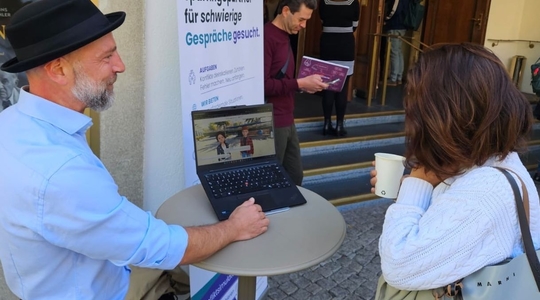
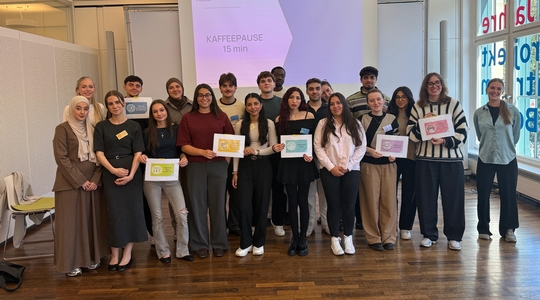
In November and December 2025, CRISP e. V. conducted three qualitative focus group discussions with a total of 27 professionals. Participants included stakeholders from schools, social work, psychology, mediation, conflict training, and music and sports clubs. The aim was to deepen the needs analysis and test the alpha prototype of the VR conflict simulator. In addition to technical testing, the rounds offered an intensive ‘deep dive’ into professional reality: participants shared concrete examples of situations of excessive demand, which we are now deconstructing in order to integrate them into the simulator as tailor-made training modules if necessary.
The discussions focused primarily on cross-room conflicts that begin, for example, in class chats or within the family and escalate into everyday school life. The professionals identified not only isolated incidents as key challenges, but rather recurring patterns of stress: lack of transparency in digital spaces, emotional escalations, and cultural and social tensions. In order to confidently address these dynamics, the participants formulated a clear need for specific methods. In particular, there is a demand for safe conversation starters, practical de-escalation strategies, and techniques for active listening and constructive handling of uncertainty.
The tested prototype was generally perceived as practical and motivating. The ‘safe space’ principle of the simulator approach was particularly highlighted: participants reported that the opportunity to practise conflict resolution without risk lowered their inhibitions about trying new approaches. It was also suggested that the simulator be made more flexible, for example by incorporating personalised scenarios from everyday working life. These suggestions are now being incorporated into further development.
The high practical relevance, the positive response to the safe space concept and the great willingness to implement it later show that a motivating and relieving effect was already achieved in the development phase.
A detailed summary of the focus group discussions is available on our website.