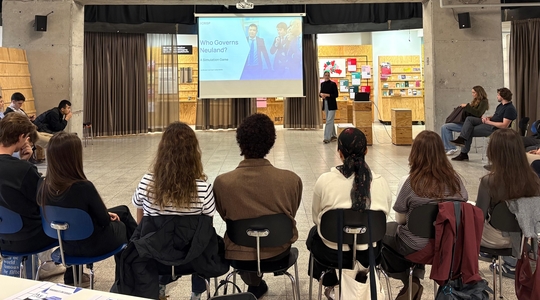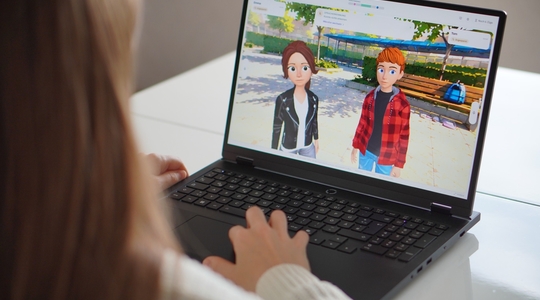


What should you do if two teenagers get into a row during break time and neither is willing to back down? This is precisely what staff at the Centre for Teacher Education (ZfL) at the University of Cologne practised on 3 November 2026 during Culture Day. We were invited to present the conflict simulator to the whole team for the first time.
The ZfL is the point of contact for around 13,000 teacher training students. Together with the faculties, partner universities and around 800 schools in the Cologne training region, it coordinates teacher training in Cologne. We first met this year at didacta. Since then, we have been in regular contact and the ZfL is participating, amongst other things, in our ongoing test phase.
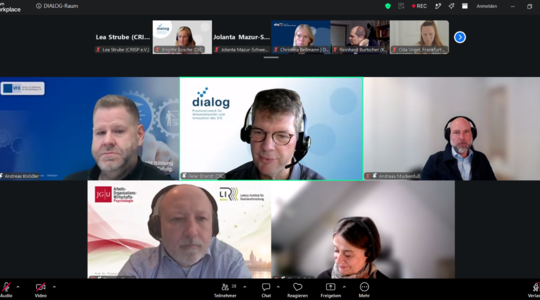
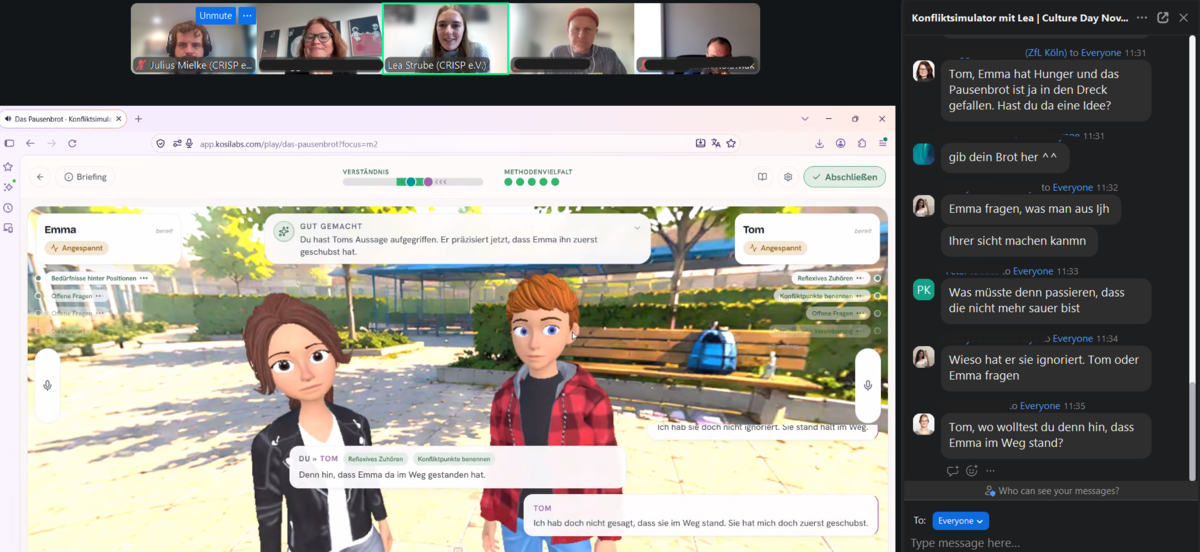
The session took place online. Our project coordinator Lea Strube and her colleague Julius Mielke joined us via video link from Berlin, whilst the participants were in their offices in Cologne. In the morning, Lea acted out the scenario ‘The Lunchbox’ live – a row between the teenagers Emma and Tom. The group decided via chat what she should say. In the afternoon, the participants conducted their own conversations with Emma and Tom in small groups. They spoke freely, alternating between leading the conversation and observing, and tried out new strategies in the second round.
The feedback was very positive. There was plenty of laughter and just as much reflection. “Noticeable learning effect,” someone noted on the shared feedback board. The conversations with Emma and Tom came across as authentic. One aspect that went down particularly well was that the pair visibly reacted when a conversation technique was working. Many also found the AI coach and the debriefing after each conversation helpful. The critical comments are just as important to us. When a conversation gets stuck, participants would like more targeted tips from the coach. The feedback will be incorporated into the programme’s further development.
Conflicts in the classroom are part of teachers’ everyday working lives, but are rarely practised during teacher training. That is why we are continuing this collaboration and will be working with trainee teachers on 18 November 2026. We would like to extend our sincere thanks to the ZfL for the invitation and the excellent organisation.
The conflict simulator is funded by the federal programme “Demokratie leben!”. The trial phase is open until 30 November 2026 for anyone who works with children and young people. Ostfalia University of Applied Sciences is providing academic support for the project. Participants will receive a one-month subscription to the premium version of the conflict simulator as a thank-you. Sign up at https://survey-staff.ostfalia.de/index.php/237176?lang=de